Nvidia B200 vs. AMD MI400: The 2026 AI Chip Crown Battle
By 2026, the race to power large‑scale artificial intelligence has crystallized into a few headline contests, and one of the most closely watched is the emerging battle between Nvidia’s B200 platform and AMD’s MI400 series. Both families target the same high‑stakes arena: training and inference for frontier‑scale models, hyperscale data centers, and enterprise AI deployments that push compute, memory, and networking to their limits.
This article explores the contours of the “AI chip crown” battle between Nvidia B200 and AMD MI400 in 2026. It looks at how each platform positions itself architecturally, the key dimensions on which buyers evaluate them, the role of software and ecosystems, and what this rivalry means for the broader semiconductor and AI landscapes.
From GPUs to AI platforms: how we reached B200 vs. MI400
The B200–MI400 rivalry is the latest chapter in a longer story: the evolution of GPUs and accelerators from graphics engines into general‑purpose parallel computing platforms. Over the past decade, Nvidia has extended its GPU architecture into dedicated AI accelerators, complemented by networking and software stacks designed for data‑center‑scale workloads. AMD, building on its own GPU heritage, has pushed into AI with accelerator lines designed to compete directly in high‑performance compute and machine learning.
By 2026, both companies have moved beyond single chips into platform thinking. “B200” and “MI400” are not just devices; they are nodes in larger systems that include high‑bandwidth memory, fast interconnects, integrated software frameworks, and reference architectures for clusters and racks. The AI chip crown battle is therefore about entire platforms, not only raw silicon.
At the same time, AI workloads have changed. Models have grown larger and more complex, parameter counts have soared, and deployment patterns now range from centralized training superclusters to distributed inference across edge and on‑prem environments. This diversity shapes what “winning” means in the B200 vs. MI400 contest: success must extend across training speed, inference efficiency, flexibility of deployment, and ease of integration with existing infrastructure.
Architectural positioning: how B200 and MI400 aim to win
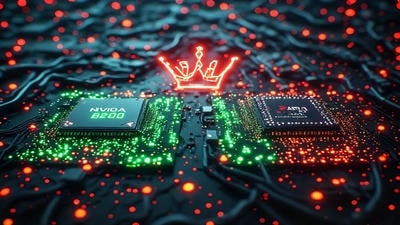
While specific implementation details differ, both Nvidia’s B200 and AMD’s MI400 can be viewed as high‑end accelerators optimized around several shared design imperatives: massive parallelism, fast access to high‑bandwidth memory, efficient data movement across devices, and support for AI‑specific data types and operations.
Nvidia’s B‑series positioning historically emphasizes tight integration with its broader stack. The accelerator architecture is tuned for deep learning workloads, with hardware support for tensor operations, mixed‑precision computing, and model‑parallel training across many devices. High‑bandwidth memory, advanced packaging, and interconnect fabrics are designed to reduce bottlenecks in feeding data to compute units and synchronizing gradients across a cluster.
AMD’s MI‑series emphasizes competitive throughput and open ecosystems. MI400 continues this trajectory by leveraging the company’s experience in GPUs and CPUs, emphasizing strong FP and mixed‑precision performance, and integrating high‑bandwidth memory and fast interconnects that fit into diverse system topologies. AMD’s strategy often highlights standards‑aligned elements—such as industry‑recognized interconnect protocols and open software stacks—to differentiate on flexibility and avoid lock‑in.
In both cases, the battle is not about marginal gains in a single metric; it is about convincing buyers that a particular architecture delivers the best balance of performance, efficiency, scalability, and integration for their target workloads.
Key dimensions of comparison in 2026 AI deployments
When hyperscalers, cloud providers, and large enterprises evaluate Nvidia B200 versus AMD MI400, they typically focus on a handful of practical dimensions rather than just headline specs.
Training throughput and time‑to‑solution. For large models, the critical question is how quickly a given cluster can complete training jobs. Buyers look at end‑to‑end throughput across multi‑GPU or multi‑accelerator systems, including communication overhead, optimizer behavior, and memory constraints. B200 and MI400 compete on how efficiently they can scale from a handful of devices to thousands in a single training run.
Inference efficiency and cost per token or query. As AI applications move into production, inference becomes a major cost driver. Evaluators compare how each platform handles real‑world inference workloads—latency, throughput, and energy per query. Inference can be more diverse than training, involving smaller models, specialized architectures, and mixed deployment environments, which tests the flexibility of each chip family.
Energy efficiency and total cost of ownership (TCO). In 2026, energy costs and sustainability metrics weigh heavily on purchasing decisions. Buyers examine not only performance per watt but also cooling requirements, rack density, and the impact on data‑center energy budgets. TCO models incorporate hardware costs, power consumption, operational overhead, and expected upgrade cycles.
Scalability and interconnect topology. Both platforms rely on fast interconnects to form clusters. Differences in topology, bandwidth, and latency influence how easy it is to build large, well‑balanced systems. Some buyers prefer architectures that align with their existing networking choices or that make it simpler to deploy multi‑tenant systems.
Flexibility across workloads. Not every workload is a giant language model. Buyers assess how B200 and MI400 perform on recommendation systems, computer vision, classic HPC workloads, and multi‑modal applications. Flexibility and generality can matter as much as optimizing for a single type of model.
This multidimensional comparison means there is no single “winner” across all use cases; instead, different buyers may choose different platforms based on their specific priorities and constraints.
The decisive role of software and ecosystems

One of the most important aspects of the B200 vs. MI400 battle is not the silicon itself, but the surrounding software and ecosystem support. AI hardware lives or dies by how easily developers can use it, how well frameworks run on it, and how robust the tooling and libraries are.
Nvidia’s longstanding strategy has been to pair its hardware with a deep, proprietary software stack: SDKs, libraries, compilers, and runtime tools tailored to its chips. This approach has built a strong developer base and large library of optimized code paths, which can make it attractive to buyers who want maturity and broad community support. B200 thus rides on an ecosystem where many frameworks already include tuned kernels and training recipes.
AMD’s MI‑series emphasizes open or cross‑vendor ecosystems. MI400 is positioned to leverage compatibility with widely used frameworks and standards, aiming to reduce friction for developers who want alternatives or multi‑vendor deployments. AMD’s focus on open tooling and collaboration with AI framework developers seeks to close gaps in ease‑of‑use and optimization.
In practice, buyers care about how quickly teams can port models, how stable and optimized training stacks are, and how easy it is to debug, profile, and scale applications. Differences in software maturity can outweigh theoretical hardware advantages. This is why the AI chip crown battle is fought not only in labs and fabs, but also in the repositories and tools that developers touch every day.
Cloud providers, in particular, evaluate the ecosystems around B200 and MI400 in terms of how they fit into their managed AI services, platform‑as‑a‑service offerings, and multi‑tenant environments. Ecosystem strength can influence which platform becomes default in major clouds, further shaping adoption.
Strategic positioning: incumbency vs. challenger momentum
Beyond technical metrics, the B200 vs. MI400 contest is shaped by strategic positioning. Nvidia enters the 2026 battle with incumbency: its prior generations of accelerators are widely deployed, and many organizations have built processes, codebases, and mental models around its stack. B200 aims to extend and reinforce that leadership.
AMD occupies the role of a challenger. MI400 is part of a strategy to capture share by offering compelling performance at competitive cost, emphasizing openness, and appealing to buyers who seek diversification away from single‑vendor reliance. For some customers, the desire to avoid vendor lock‑in and maintain bargaining power is itself a factor in a multi‑platform approach.
Hyperscalers and large enterprises often adopt a mix: they experiment with MI400 while continuing to rely heavily on B‑series platforms, or they deploy different platforms in distinct regions or services. This multi‑platform reality means success is not purely zero‑sum. The AI chip crown can be shared in practice, even if the market discourse frames it as a duel.
Yet strategic momentum still matters. Wins in flagship deployments—high‑profile cloud offerings, national AI infrastructure projects, leading research institutions—can tilt perception and influence future decisions. Both Nvidia and AMD compete fiercely for these anchor wins to establish their platforms as default choices in key segments.
What this battle means for the broader semi industry

The B200 vs. MI400 contest has ripple effects across the broader semiconductor ecosystem. Each platform drives demand for upstream components: high‑bandwidth memory, advanced packaging technologies, power semiconductors, and high‑speed interconnect chips. Their success shapes which suppliers grow fastest and where investments in capacity and technology concentrate.
Advanced nodes at leading foundries underpin both platforms. Strong demand for either B200 or MI400 translates into sustained utilization at cutting‑edge process technologies, influencing capex decisions, node migration timelines, and the pace of innovation in lithography and manufacturing. In turn, this affects the economics for other customers sharing those nodes.
Downstream, the AI chip battle influences data‑center design. Power distribution, cooling, rack architecture, and network fabrics are all shaped by the performance and requirements of the chosen accelerators. Choices made by early adopters can drive standards and best practices for future facilities.
For other semi companies—both large and niche—the B200–MI400 rivalry underscores the importance of differentiation, ecosystem building, and long‑term roadmaps. It shows that winning in AI is about sustained platform development and deep customer engagement, not just launching a single strong product generation.
Guidance for buyers navigating the 2026 AI chip decision
Organizations deciding between—or combining—Nvidia B200 and AMD MI400 in 2026 can benefit from a structured approach to evaluation. Several practical considerations can guide these decisions.
First, clarify workload profiles. Understanding the mix of training versus inference, model sizes, data types, and deployment patterns helps determine which strengths matter most. Some workloads may favor one platform’s memory and interconnect characteristics; others may benefit more from ecosystem maturity.
Second, build pilot deployments and proof‑of‑concepts. Testing real models on both platforms, measuring end‑to‑end performance, and assessing developer experience yields better insight than relying solely on spec sheets. Pilot results can reveal operational nuances like job scheduling, monitoring, and reliability.
Third, evaluate long‑term ecosystem and vendor relationships. Buyers should consider how each platform fits into their wider strategy: integration with existing tools, support offerings, roadmap alignment, and the ability to influence future features. The AI chip crown battle will continue beyond a single purchasing cycle, and alignment over multiple years matters.
Fourth, incorporate risk management. Multi‑vendor strategies, balanced inventory profiles, and flexible software stacks can reduce exposure to any single platform’s roadmap changes or supply constraints. The choice is often not simply “B200 versus MI400,” but “how much of each, in which contexts, over what time horizon.”
Using this structured lens helps buyers cut through hype and focus on decisions that match their actual needs and constraints.
Conclusion: a crown defined by platforms, not just chips
The battle between Nvidia B200 and AMD MI400 for the 2026 AI chip crown encapsulates the state of modern computing: AI workloads driving the frontier of performance and efficiency, platforms competing on both silicon and software, and buyers weighing not only raw speed but total cost, ecosystem depth, and strategic positioning.
Whatever the scoreboard of market share or benchmark results, one lesson is clear: the AI crown is no longer awarded to a single chip in isolation. It belongs to platforms that combine strong architectures, rich software ecosystems, and sustained innovation. In that sense, the 2026 B200 vs. MI400 contest is less a one‑time duel and more a long‑running race, shaping the trajectory of AI infrastructure and the broader semiconductor industry for years to come.